

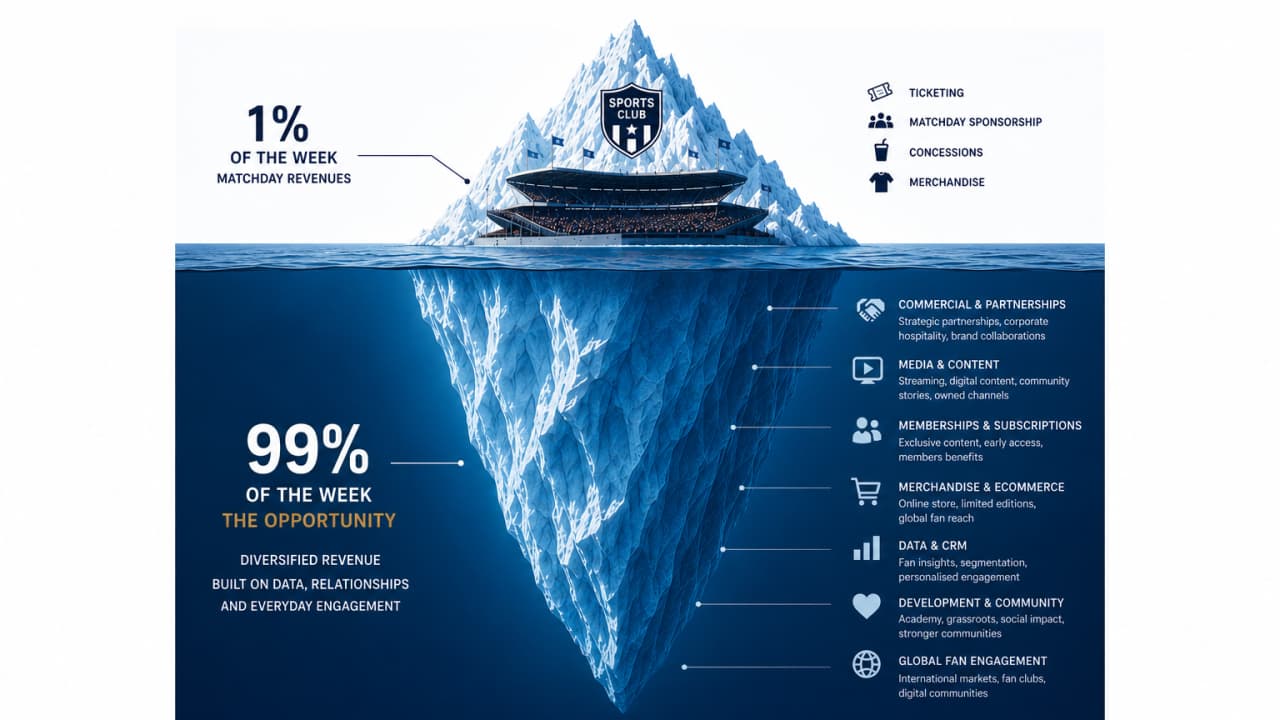
Every sports executive I have ever spoken to knows that their organisation generates the vast majority of its revenue from a handful of hours a year. They know the rest of the time — the days and weeks between events when their audience is out there, spending money on other things — represents an almost entirely untapped commercial opportunity.
They have known this for years. Most have chosen, consciously or otherwise, not to solve it. Not because they lack ambition. But because the next match always comes first. There are 10,080 minutes in a week, but rugby, for example is reliant for 80-95% of its income on the weekly 80 minute live event. What about the remaining 10,000 minutes?
The problem is that three things are now happening simultaneously that mean this can no longer be quietly deferred.
Private equity is arriving with different expectations. According to our annual Sports Leadership Benchmark Report, more than a third of UK sports rights-holders anticipate significant third-party investment in the next twelve months. As one prominent sports investor put it at a recent PTI roundtable: “A growth strategy that is 100% focused on pushing the chips all in on athletes shows little imagination. What are the plans for infrastructure, technology, data? Otherwise in twelve months aren’t we just back at the table asking for more money?” When the return timeline meets the reality of the current commercial model, boardroom conversations are going to get uncomfortable quickly.
The talent has better options. The data strategists, CRM specialists and digital product managers who know how to build what sport needs can work for businesses that treat this capability as a growth driver rather than a cost centre. The risk is not just that sport lacks this capability today — it is that the culture which makes it hard to build is also the culture that makes it hard to attract the people who could change it.
The audience is not standing still. Younger generations are not developing the same habitual relationship with live sport their parents did. The businesses competing for their attention are engineering daily return visits with sophistication and budget that sport cannot match — during precisely the time that sport has no strategy for.
The good news is that sport starts with an emotional advantage no competitor can manufacture. The attachment fans feel is real, deep and extraordinarily durable. The infrastructure to sustain and monetise it year-round is not beyond reach. It just requires leadership willing to make the long-term argument in a room full of short-term pressure.
As one leader at a recent PTI roundtable put it: “Sport has always found another pot of gold. But that’s not a strategy.”
The pot is getting harder to find. And the people who might help you dig for may be starting to look elsewhere.
The third edition of our Sports Leadership Benchmark publishes in September. Get in touch if you’d like to receive it on publication.
