

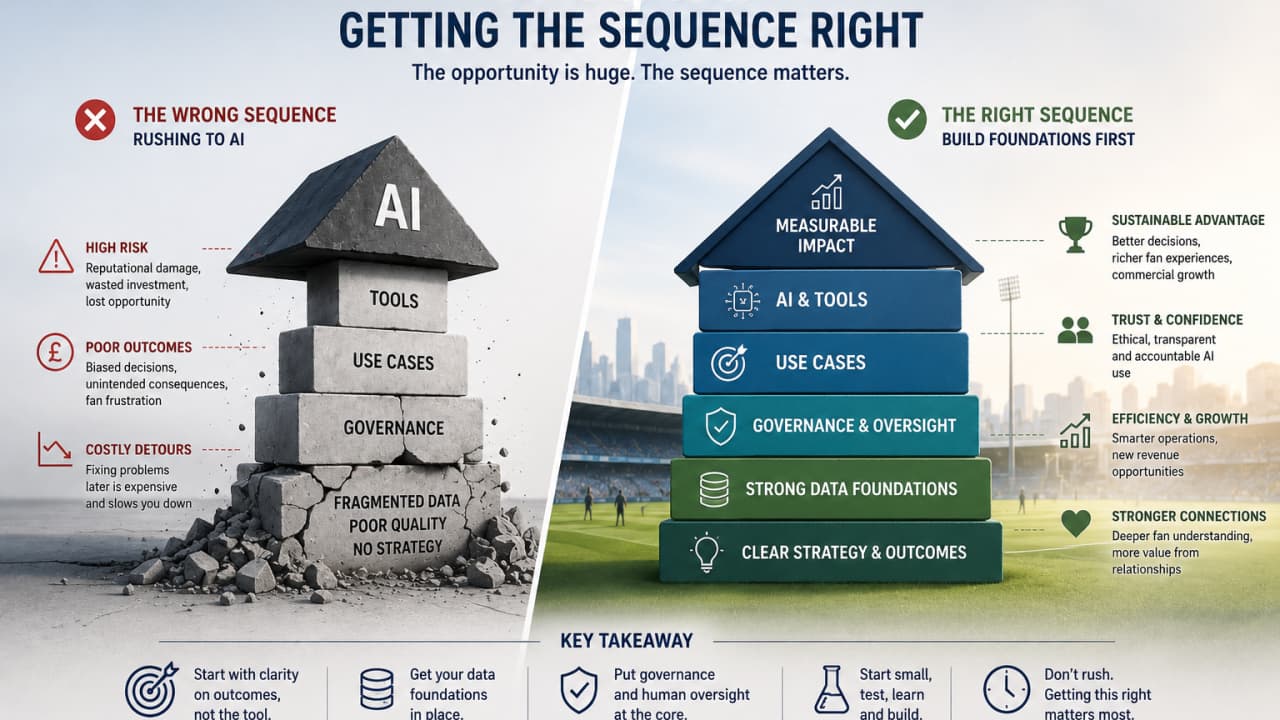
There is no shortage of breathless AI commentary — much of it authored by businesses with AI products to sell. We want to offer something different. Not hype. Not fear. Just a clear-eyed, practical framework for sports organisations that are excited about the possibilities but not sure where to start.
According to our forthcoming 2026 Sports Leadership Benchmark, 82% of UK sports organisations are now using AI in some form — a dramatic rise on previous years. But drill into that number and a more nuanced picture emerges. Only 33% are using it strategically to drive cost efficiencies or revenue growth. The majority are deploying it for data visualisation, research or graphic design — useful, but not transformative.
This is absolutely fine. In fact, it is exactly as it should be.
The Golden Rule: Garbage In, Garbage Out
AI is only ever as good as the data that feeds it. If your data is fragmented, incomplete or commercially unexploited — and our Sports Leadership Benchmark consistently shows that for most UK rights-holders, it is — layering AI on top will not produce better outcomes. It will produce worse ones, faster.
Rushing to AI before the data foundations are in place is like building a house starting with the roof. The sequence matters enormously, and getting it wrong is costly.
The Fail Potential is Real
Before we get to the opportunity, it is worth understanding what happens when organisations rush in without the right foundations or governance.
McDonald’s launched voice-ordering AI at its drive-throughs. It went viral for entirely the wrong reasons — misheard orders, unwanted items, no human fallback. It was pulled after widespread mockery and significant reputational damage.
Pizza Hut deployed a delivery optimisation tool that changed driver behaviour in ways nobody had modelled. Drivers batched pickups, food went cold, and one franchisee is estimated to have lost over $100 million in sales and enterprise value. The tool optimised for one variable and ignored how people would actually respond.
Amazon built a recruiting tool trained on a decade of its own hiring decisions. Because those decisions had been predominantly about male candidates, the model taught itself to downgrade female applicants — and because it learned from its own outputs, the bias compounded rather than corrected.
These are not under-resourced organisations. The lesson is not that AI is dangerous. It is that without clean data, clear governance and human oversight, the downside is significant — and it scales.
Sport’s Specific Opportunity
Here is the genuinely good news: sports organisations are better placed than most to benefit from AI, when the foundations are right.
The assets that matter most in an AI-powered commercial world are not ones Silicon Valley can manufacture. First-party fan data, purchase history and behavioural signals are impossible to replicate. The emotional pull of live sport is irreplaceable. Sporting heritage passed down through families and friends gives AI output meaning and commercial value that generic models cannot produce.
The models will commoditise. Everyone will have access to broadly the same underlying technology. What will not commoditise is the context you point it at — your audience, your data, your relationships. That is already yours. You just need to be in a position to use it.
Where to Start?
The sequence matters. Start with clarity on what you are actually trying to achieve — AI is only as useful as the brief it receives. Get your data foundations in place before reaching for AI tools. Build a governance framework covering who can use AI, for what purpose and with what oversight. Then start small, test, learn and build from there.
Do not start with the tool. Start with the outcome. And do not give your audience data to AI vendors in exchange for short-term capability — it is not free, even when it is presented that way.
Above all, do not be in a rush. Getting this right matters far more than being first.
Our Making Sense of AI guide publishes in September alongside the third edition of our Sports Leadership Benchmark. If you would like a copy of either — or want to talk through where your organisation sits on the data and AI maturity curve — get in touch.
