

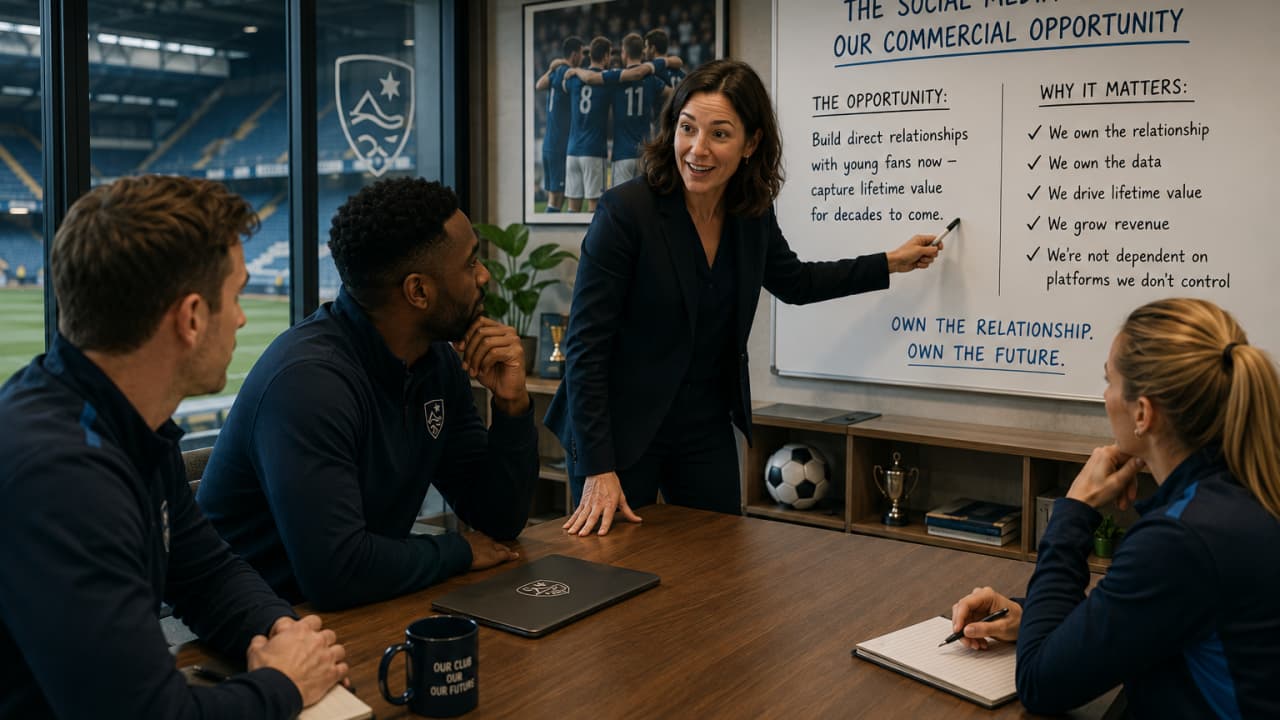
The UK government’s pending ban on under-16s using social media could, if it passes, represent the most significant shift in youth audience behaviour in a generation. For UK sport, it should be this could be a moment in time.
Regardless of where you might stand on the proposed legislation, sport did not need a government ban to recognise that building its entire next-generation audience strategy on platforms it does not own, does not control, and which share neither data nor meaningful revenue with it was a profound strategic error. The evidence has been there for years. We chose to just go with the flow.
Our annual Sports Leadership Benchmark Report tells the story. Just 12% of rights-holders say data is integrated into commercial decision-making. Only 20% measure customer lifetime value. Silicon Valley got very rich. Sport got follower counts it cannot monetise, serving an audience it cannot identify, on platforms it does not control.
A Generation of Outsourced Relationships
The under-16 cohort is not just a junior membership opportunity. It is the top of the most valuable commercial funnel in sport. A fan acquired at 12, nurtured through adolescence, and converted into an adult supporter is worth multiples of one acquired at 25 — in ticket revenue, merchandise, data value and advocacy. Yet most organisations have no model for that lifetime value and no owned environment in which to build the relationship.
Instead, we handed the job to Instagram and TikTok, congratulated ourselves on the engagement metrics, and called it a youth strategy.
Own the Environment, Own the Relationship
The ban — and the broader cultural shift away from traditional social media among younger audiences already underway — creates a genuine forcing function. That audience is now in motion. The question is where it lands, and whether sport is ready to receive it.
The answer is not to find the next TikTok. That is the same reflex that created the problem in the first place. The answer is to build or invest in owned environments — whether that is a dedicated youth platform, an immersive gaming presence such as Roblox, or a structured junior membership programme — where sport controls the experience, owns the data, and builds the relationship on its own terms.
The distinction matters enormously. A social media account gives you reach and no data. An owned environment gives you an engaged audience, behavioural insight, and the foundation of a long-term commercial relationship. That data, compounded over years, becomes the basis of something genuinely valuable — the ability to understand and serve your audience better than anyone else can.
The Real Barrier Is Not Technology
As our SLB Report consistently shows, this is not primarily a technology challenge. It is a cultural one. Youth engagement has long been treated as a cost rather than the top of a commercial funnel that, properly managed, produces the most valuable long-term customers a sports organisation can have.
Until boards treat it as the latter, no platform strategy will be sufficiently funded or sustained to make a difference. The investment case has to be built on lifetime value. And that requires organisations to first do the work of understanding what a long-term fan is actually worth — something the majority have not yet done.
The ban may be coming. The audience is already moving. For once, sport has advance warning of a structural shift rather than being forced to react after the fact.
The only question is whether we use it.
